Written by: Ryan Dunlop, CEO and Founder of Full Arch Masters and graduate from the Harvard School of Dental Medicine
Key Outcomes You Can Expect With the FAM Method
- Hybrid workflows with physical impressions and off-site labs limit most practices to one or two full-arch cases per month and leave patients without fixed teeth on surgery day.
- The FAM Method connects intraoral scanning, photogrammetry, CBCT, and in-house 3D printing into a repeatable seven-step digital workflow that delivers same-day screw-retained provisionals in 2–4 hours.
- Team delegation sits at the center of the system: the lead assistant owns records, the lab technician owns design and print, and the dentist focuses on clinical decisions, which removes the solo-operator bottleneck.
- Practices adopting the FAM Method report adding over $1M in annual revenue by scaling to five-plus arches per month at higher margins with lower remake rates.
- Ready to implement the FAM Method in your practice? Train your full team on the complete end-to-end system at Full Arch Masters.
Why a Fully Digital Full-Arch Workflow Changes Your Practice
The operational difference between a hybrid and a fully digital workflow is significant, not incremental. Digital workflows can reduce overall case turnaround compared to analog methods, often shortening total case duration and cutting the number of appointments. Remake rates can be lower in CBCT-guided digital workflows compared to traditional approaches.
For patients, this difference means fixed teeth the same day instead of a removable denture on swollen tissue. For the practice, it separates a schedule with one or two arches per month from a scalable, high-margin volume procedure. This revenue increase, driven by more cases at higher margin with a trained team executing a repeatable system, turns the FAM Method into a practice transformation rather than a single clinical technique.
Passive prosthetic fit is also a clinical imperative, not just an efficiency metric. A prosthesis that does not fit passively transmits tension to the implants and surrounding bone, increasing the risk of implant failure over time. Photogrammetry’s accuracy advantage directly reduces that risk.
The FAM Method: Your End-to-End Digital Full-Arch System
The FAM Method is Full Arch Masters’ proprietary digital workflow and the only training program that delivers a fully integrated, end-to-end operating system for full-arch implant restoration. It combines intraoral scanning, photogrammetry, facial scanning, CBCT, immediate-load 3D-printed conversion, and exocad design into a single repeatable sequence. The system is taught as a team workflow, because the dentist alone cannot execute it at volume.
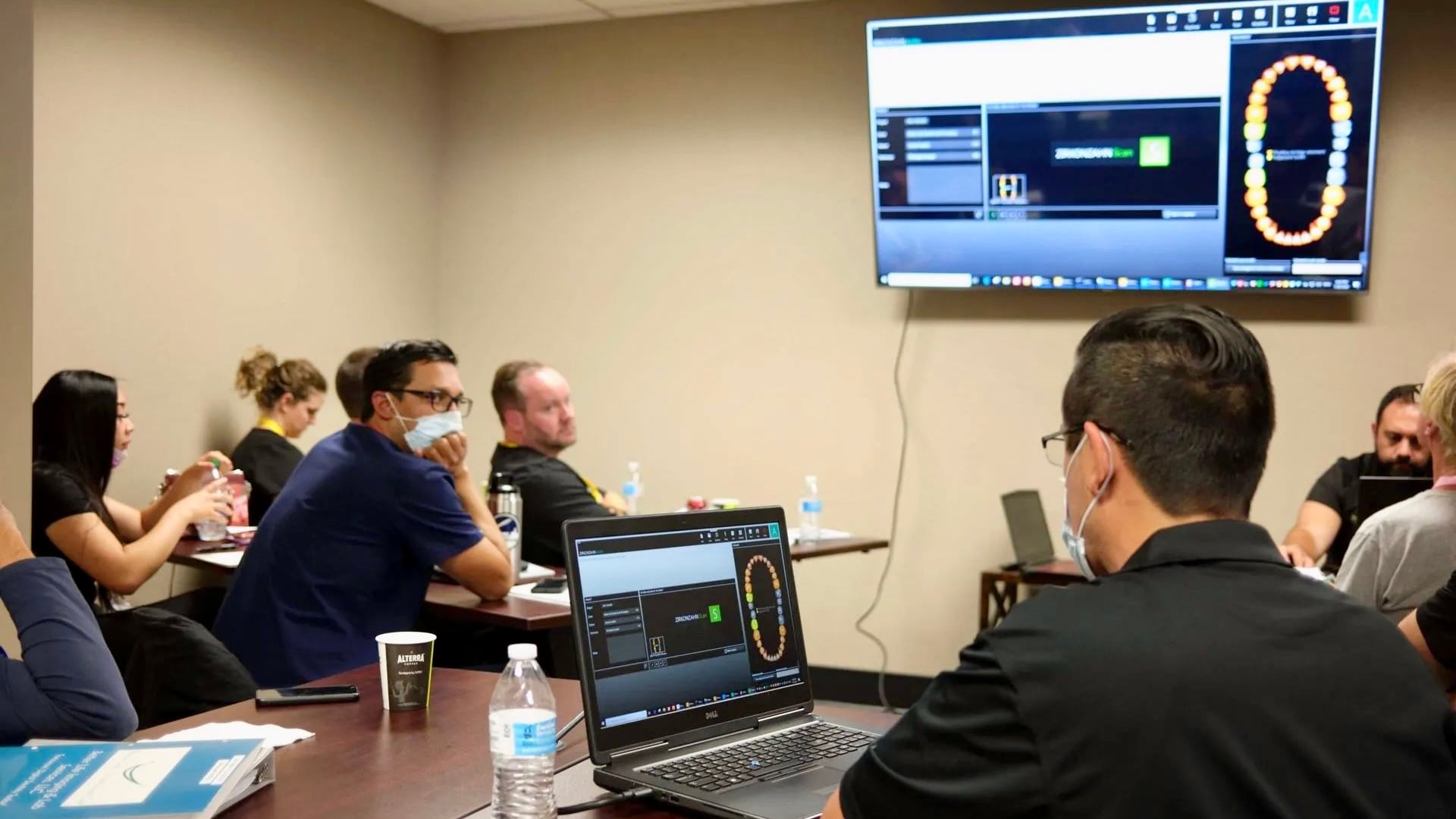
The FAM Method runs in seven steps. Each step has defined inputs, outputs, stakeholders, and handoff points. The sequence below outlines how those steps work together in daily practice.
Step 1: Pre-Operative Records Acquisition
Pre-operative records create the data foundation for every downstream decision. The inputs include a full-arch intraoral scan, a CBCT, a facial scan, and photographs. In a solo-operator practice, the dentist often captures all of these personally, which consumes 60–90 minutes of billable chair time on non-billable tasks. This bottleneck is why the FAM Method trains the full team on records acquisition so the dentist’s time is reserved for clinical review and decisions.
In a FAM-trained four-person team, the lead assistant and treatment coordinator handle records acquisition while the dentist reviews the data. The FAM Method trains the full team on records protocols, including intraoral scanner technique, photogrammetry setup, and CBCT positioning. Delegation becomes part of the workflow from day one instead of an afterthought.
Step 2: Case Planning and Surgical Guide Design
CBCT data flows into exocad for virtual implant planning. The surgeon reviews bone volume, identifies anatomical landmarks, and positions implants digitally before touching the patient. A surgical guide is designed from the plan and 3D-printed in-house.
The lab technician handles the design and print, and the dentist reviews and approves the plan. The handoff stays clean because both roles trained on the same system and follow the same digital steps. Point-based CBCT-to-surface scan registration in virtual implant planning can provide the precision needed for guided surgery and same-day delivery.
Step 3: Surgery and Implant Placement
Surgery follows the digital plan created in exocad. The surgical guide directs implant position, angulation, and depth. Real-time decision points such as primary stability torque, bone quality, and MUA selection are made by the surgeon based on pre-established criteria.
Historically, implants achieving insertion torque above 35 Ncm were considered to qualify for immediate loading to ensure primary stability, though recent evidence suggests lower values may suffice under specific conditions.
Immediately after placement, photogrammetry replaces the analog impression step entirely. ICamBodies are scanned extraorally with the ICam4D unit, and the resulting data is used to design and print the temporary prosthesis the same day, with no analog master cast or verification jig required. This step compresses the workflow timeline from hours to minutes.
Step 4: Immediate-Load Conversion and Delivery
The photogrammetry scan data imports into exocad for prosthetic design. The immediate-load provisional prosthesis is designed digitally and sent to the in-house 3D printer. Using this approach, a 3D-printed immediate transitional restoration can be delivered the same day after full-arch implant surgery.
The patient leaves with fixed, screw-retained teeth the same day, which defines the FAM Method’s 2–4 hour delivery target. No luting, no bite adjustment on analog material, and no physical models are required. The digital file is archived and available for rapid reproduction if needed.
Step 5: Final Prosthetic Design and Finishing
After osseointegration, typically 3–6 months post-surgery, the final prosthesis is designed in exocad using the archived photogrammetry data as the foundation. Material selection depends on the prosthetic classification. PMMA is used for provisionals, zirconia for most finals, with PEEK and metallic frameworks reserved for specific clinical indications.
The lab technician handles green-stage contouring and MIYO ceramic layering for aesthetic finishing. The dentist reviews and approves the design before milling or printing begins.
Step 6: Team Delegation and Handoff Protocols
Delegation functions as a structured protocol in the FAM Method, not a soft suggestion. Each team member follows a defined role checklist. The lead assistant owns records acquisition and photogrammetry setup, the lab technician owns design and print, the treatment coordinator owns the consultation pipeline and case documentation, and the dentist owns clinical decisions and final approvals.
Quality-control checkpoints exist at every handoff. Records are reviewed before planning begins, design is approved before printing starts, and fit is verified before delivery. The primary root cause of delegation failure is missing infrastructure, such as undocumented workflows, unclear ownership boundaries, and no accountability structure. The FAM Method builds SOPs into the training so practices do not have to create them from scratch.
Step 7: Post-Delivery Follow-Up and Refinement
Follow-up appointments at 1 week, 1 month, and 3 months post-delivery capture occlusal adjustments, tissue response, and patient-reported outcomes. The digital archive enables objective comparison across time points. Serial intraoral scan superimposition using reverse engineering software enables objective longitudinal tracking of material wear volume and framework stability in full-arch rehabilitations.
Refinements are documented and fed back into the team’s SOPs. This process creates a continuous improvement loop that tightens the workflow over time.
Frameworks That Make a Four-Person Team Run Full-Arch at Scale
The difference between a solo operator and a FAM-trained four-person team comes from system capacity, not clinical skill. A solo operator who performs records acquisition, case planning, surgery, and prosthetic design personally becomes the bottleneck in every case. A trained team distributes that work across defined roles so the dentist can focus on the steps only a dentist can perform.
In practice, a solo operator running one arch per month at 6–8 hours of chair time per case faces a hard ceiling on volume. A four-person team running the FAM Method can execute the same case in 2–4 hours of dentist chair time, with the remaining work handled by trained team members before and after surgery. That compression makes five-plus arches per month operationally achievable without burning the dentist out.
Ready to Learn the Full FAM Method?
Full Arch Masters teaches the complete FAM Method across a five-course curriculum built for the full dental team. The training covers all seven steps, team delegation protocols, exocad design, photogrammetry setup, and immediate-load conversion.
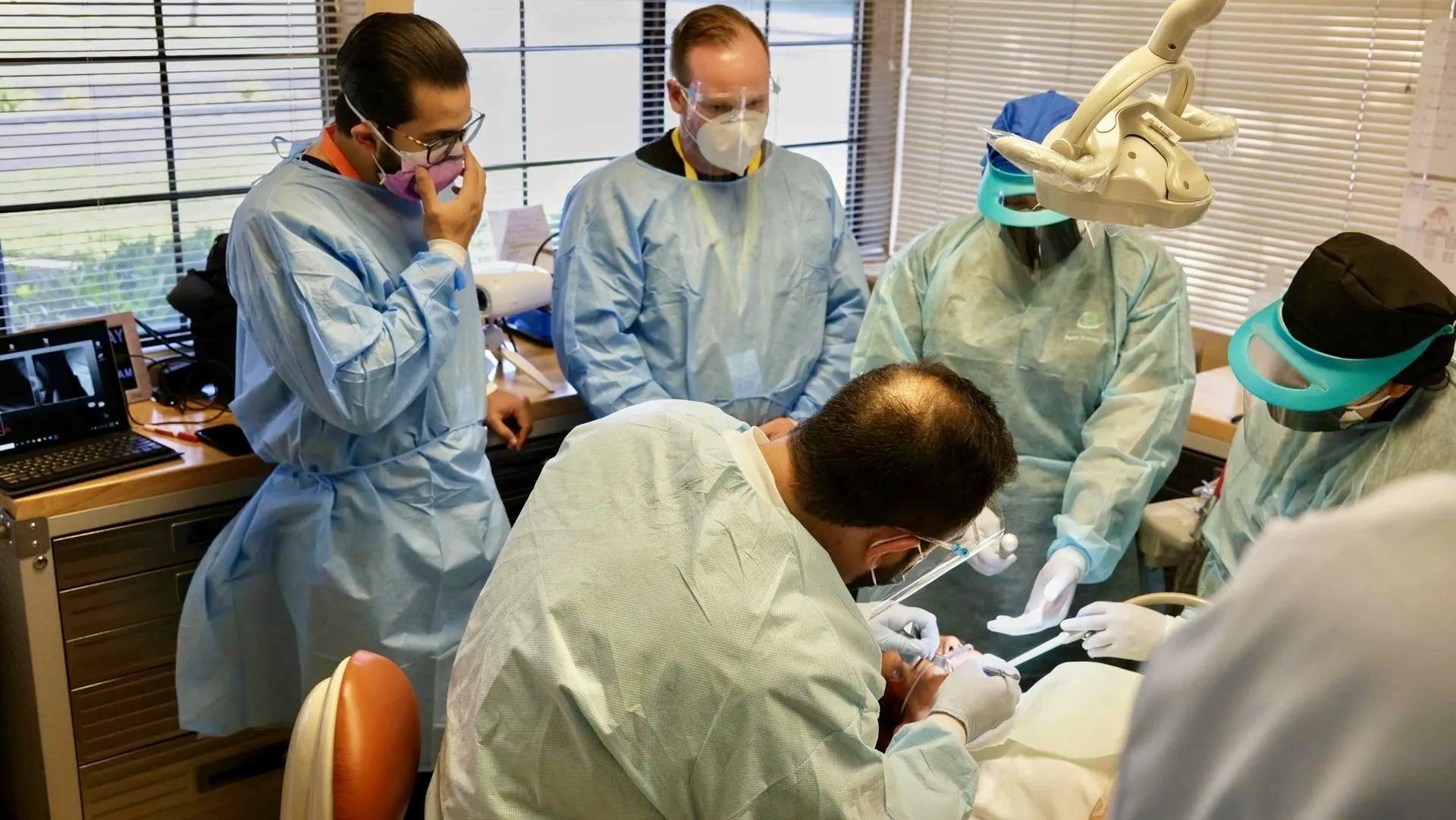
Bring your team to Full Arch Masters and master the complete workflow together.
Troubleshooting Common Obstacles in Digital Full-Arch Adoption
Three obstacles appear consistently in practices transitioning to a fully digital full-arch workflow, and all three relate to team structure and enablement. Practices that address these issues early move to predictable same-day delivery faster.
Slow records acquisition. When the dentist personally captures all pre-operative records, cases back up and chair time is consumed by non-billable tasks. The fix is training the lead assistant on intraoral scanning and photogrammetry protocols, which sits at the core of the FAM Method’s team delegation framework.
Poor lab handoff. The second obstacle compounds the first. When the clinical and lab sides of the practice are not trained on the same system, handoff friction creates delays, remakes, and miscommunication. Training alone is rarely enough for successful adoption; adoption succeeds when the workflow is integrated into existing processes and connected to the everyday tasks teams already perform. Bringing the lab technician to training alongside the dentist eliminates this friction at the source.
Inconsistent case acceptance. The third obstacle shows up at the front of the pipeline. Practices that close 30–40% of full-arch consultations leave significant revenue on the table. The FAM Method’s treatment coordination training, including the closing system used by FAM’s in-house treatment coordinator who maintains an 80% closing rate, addresses this directly.
Measuring Success With Clear Workflow Metrics
Four metrics define workflow performance in a FAM-trained practice:
- Turnaround time from records to delivery: Target same-day provisional delivery within 2–4 hours of surgery. Baseline measurement is the time between photogrammetry scan completion and prosthesis insertion.
- Remake rate: Digital CBCT-guided workflows can achieve lower remake rates compared to traditional workflows. Tracking remakes by cause, such as fit, occlusion, or aesthetics, identifies which step in the workflow needs refinement.
- Case acceptance percentage: The ratio of full-arch consultations to signed treatment plans. FAM’s in-house benchmark is 80%. Practices below 50% typically face a treatment coordination gap rather than a clinical gap.
- Monthly arch volume: The number of full arches delivered per month. Most practices start at one to two, and the FAM Method is designed to scale that number to five-plus with a trained team.
Scaling to Five-Plus Arches per Month With Advanced Training
Scaling beyond two arches per month requires a team that can execute the workflow without the dentist as the bottleneck and a case pipeline that consistently fills the surgical schedule. The FAM Method addresses both requirements through team training and treatment coordination systems.
For atrophic cases, where patients have severe bone loss and cannot receive standard implants, the FAM Method’s advanced surgical training covers zygomatic, pterygoid, trans-sinus, and palatal-approach placements. These cases create a significant referral opportunity for practices that can handle them and a revenue ceiling for those that cannot. The FAM Live Surgical Course’s Advanced Operator track, gated to dentists with 200 or more career arches placed, addresses this gap directly.
Team-based iteration also supports scaling. Post-case debriefs, tracked against the four metrics above, identify where the workflow is losing time or generating remakes. Successful organizations treat enablement as an ongoing process built around evaluation, feedback, refinement, and continuous support rather than a one-time event. FAM’s continued alumni community, with private group chats for hundreds of FAM-trained dentists, lab technicians, and team members, provides the peer infrastructure for that iteration.
Frequently Asked Questions
How long does it realistically take to deliver a full-arch prosthesis using the FAM Method?
The FAM Method targets same-day provisional delivery within 2–4 hours of implant surgery. That timeline depends on photogrammetry capture immediately after implant placement, in-house 3D printing capability, and a trained team executing the design and print steps concurrently with the surgical close. Practices without in-house printing can still achieve same-day delivery by transmitting digital files to a nearby lab with rapid turnaround. The final prosthesis, typically zirconia, follows after osseointegration, generally 3–6 months post-surgery.
Does my entire team need to attend the course, or can I bring just the dentist?
The FAM Method is built around full-team execution. A dentist who returns from training without a trained team cannot operationalize the workflow at volume, because the delegation protocols, records acquisition steps, and lab handoffs all require trained team members to function. Most FAM attendees come as a practice owner with their lead assistant and treatment coordinator, or as a dentist with their in-house lab technician. Team-member pricing is built into every course at $2,500 per additional team member for the Flagship Course.
What post-course support does Full Arch Masters provide?
Every attendee joins FAM’s continued alumni community, which includes private group chats with hundreds of FAM-trained dentists, lab technicians, and team members, for ongoing case help, equipment troubleshooting, and clinical peer support. Alumni also receive the complete digital resource library covering surgical room setup checklists, finishing techniques, treatment coordinator forms, and consent templates, and gain access to the KOL (Key Opinion Leader) buying group for vendor discounts on implants, exocad licenses, 3D printers, and photogrammetry systems at no recurring cost.
What are the regulatory considerations for the Live Surgical Course?
The FAM Live Surgical Course is hosted in Parker, CO because the Colorado Dental Board allows US-licensed dentists from any state to perform dentistry on volunteer patients during the course. FAM submits each operator’s credentials to the board ten days before the course, contingent on no pending marks against the dentist’s license in their home state. International dentists cannot be credentialed by the Colorado Dental Board and attend as Observers. Basic and Advanced operators each perform two full-arch cases across the two surgical days under expert mentor supervision.
When is the right time to pursue refinements after immediate-load delivery?
Minor occlusal adjustments are typically addressed at the one-week post-delivery appointment. Significant refinements, such as changes to vertical dimension, occlusal scheme, or prosthetic contour, are deferred until the one-month appointment, when tissue has stabilized and the patient has adapted to the new occlusion. The final prosthesis design incorporates all refinement data from the provisional phase, using the archived photogrammetry file as the baseline. This sequence forms part of the FAM Method’s Step 7 follow-up protocol and is covered in detail during the Flagship Course.
Bring the FAM Method Into Your Practice
The FAM Method delivers what no other full-arch training provides: a complete digital operating system taught as a team-based workflow, combining photogrammetry-first records acquisition, exocad design, immediate-load 3D-printed conversion, team delegation protocols, and a continued alumni community in a single integrated curriculum that achieves same-day delivery in 2–4 hours.
Alumni report substantial practice growth after adopting the workflow. The continued support and vendor relationships you gain as an alumnus extend for the life of your practice, not just the duration of the course.
Full Arch Masters keeps the recipe open to every practice willing to train the team to run it.
Start implementing the FAM Method in your practice and register for the next available course.